
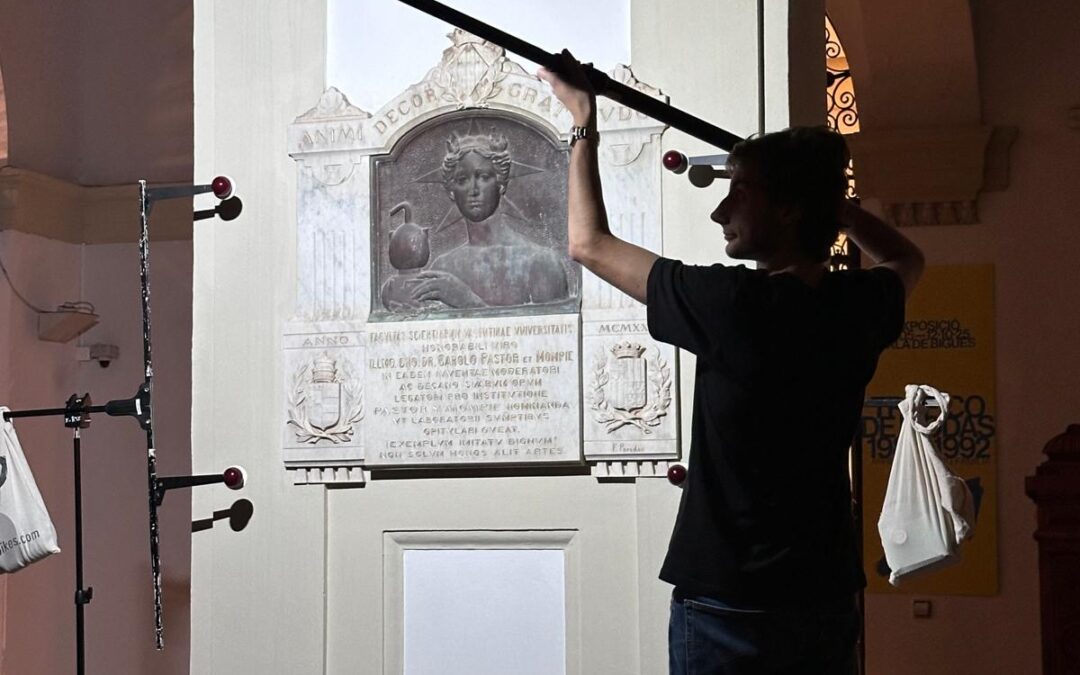
Valencia, 30 September 2025 — Between 30 September and 3 October, the expert conservation team of the ChemiNova consortium completed its second data acquisition campaign at the Faculty of Geography and History and the historic La Nau building of the University of Valencia.
Together, they are applying a battery of advanced conservation techniques, such as photogrammetry, Hyperspectral Imaging (HSI), Multiband Technical Imaging (MBI), and Reflectance Transformation Imaging (RTI), to study a variety of works. These include paintings affected by the DANA climate emergency in 2024, the heritage sculpture of Luís Vives, and architectural elements such as the ornamental fountain in the main cloister of the La Nau building, and the building’s roof.
This phase is fundamental to the project’s future. It will enable a comparison between the current state of conservation with the first data acquisition campaign carried out last year. This campaign focuses on the collection of technical information to refine the project’s damage assessment and monitoring tools.
This effort aligns with the project’s mission to develop an advanced computational system for the monitoring, analysis, and preservation of European cultural heritage against threats such as climate change or armed conflicts. These tools are intended for integration into the workflows of conservation professionals.