Databeers VLC: Cultural Heritage in the Age of Data
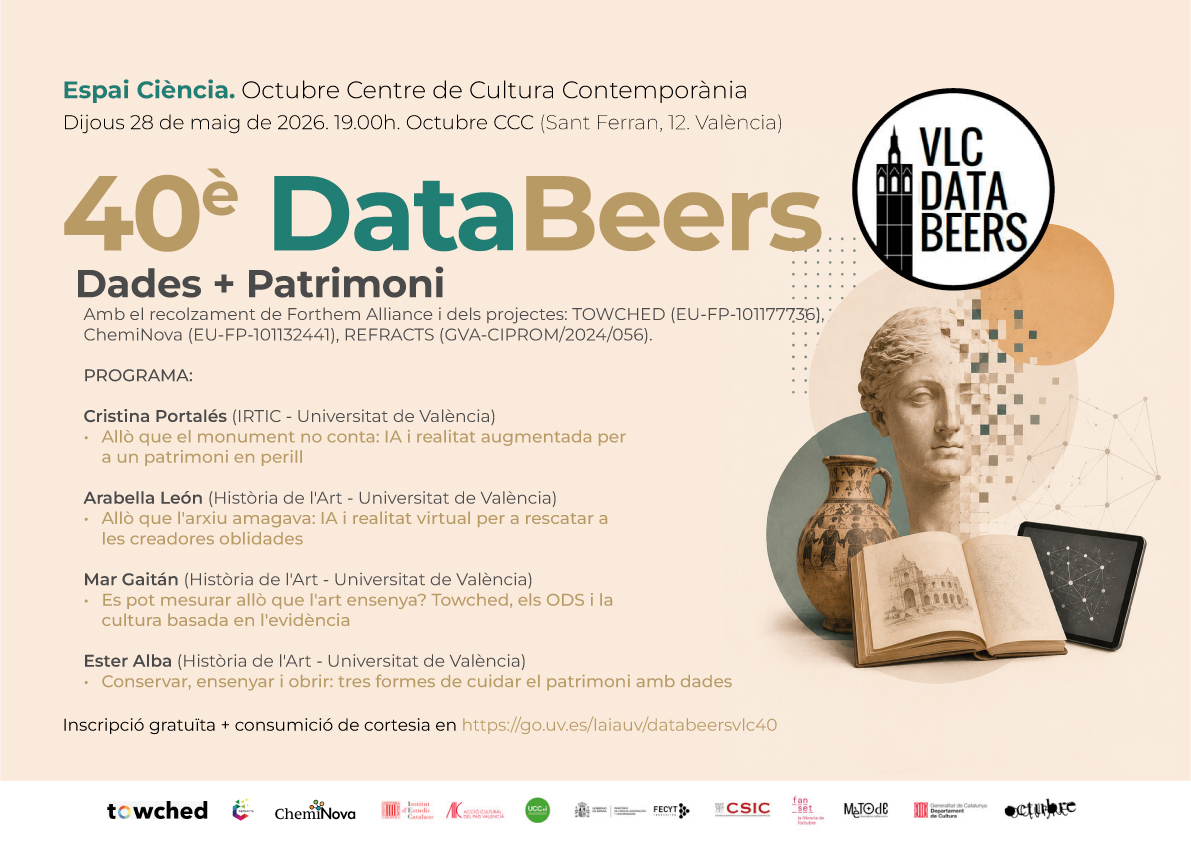
The upcoming Databeers VLC (databeersvlc.com) event presents an exceptional opportunity to explore the convergence of the Humanities and Digital Transformation. On this occasion, the Department of Art History and the Robotics and Information and Communications Technologies Institute (IRTIC) at the University of Valencia present the session: “Conserve, teach, and open: cultural heritage through the lens of data.”
A bridge between academia and society
Databeers VLC is an established science communication initiative aimed at demystifying data science through brief, dynamic talks in an informal setting. By moving the discussion from the classroom to a public space, it fosters a more fluid exchange of knowledge between specialists, professionals from the cultural sector, and the general public.
Research excellence with European backing
The event highlights the importance of technology transfer in protecting historical memory. The programme will feature researchers linked to cutting-edge projects leading international innovation in heritage:
-
TOWCHED (EU -101177736): A project focused on how heritage connects with education, based on human rights (MEL methodology) and SDGs.
-
ChemiNova (EU -101132441): A project focused on the creation of advanced tools for the conservation of cultural heritage, including in-situ and remote monitoring in the face of climate change and armed conflict.
-
REFRACTS (GVA-CIPROM/2024/056): A project based on how archives can be protected, disseminated and connected through new technologies (such as AI and the semantic web) from a gender perspective, highlighting the role of women creators.
This meeting receives strategic support from the Forthem Alliance, reinforcing the University of Valencia’s commitment to the European university network in creating a common space for education and open science.
Invitation and Registration
The organisers invite professionals, students, and culture and technology enthusiasts to participate in this outreach event. Given the nature of the event and limited capacity, prior registration is essential.
-
Official Registration:
https://databeersvlc.com/ -
Time: 19:00 (or 7:00 pm).
-
Location: Octubre Centre de Cultura Contemporània (12 San Fernando Street, Valencia).
This activity is developed within the collaborative framework of the European research projects TOWCHED and ChemiNova, and the regional project REFRACTS, with the aim of enhancing the visibility of research results funded by the European Union and the Generalitat Valenciana.
What the monument doesn’t tell us: AI and augmented reality for heritage at risk
Cristina Portalés
IRTIC – University of Valencia
European cultural heritage is fragile and often at risk of being lost, particularly in the face of two human-induced threats: climate change and armed conflict. ChemiNova proposes to protect it by combining Artificial Intelligence, Augmented Reality, and enriched 3D models. These “digital twins” overlay various layers of information—colour, multispectral, hyperspectral, RTI, and thermal—capable of revealing damage invisible to the human eye. With a people-centred approach, it seeks to place technology at the service of those who care for heritage and the citizens who claim it as their own. Heritage ceases to be static, becoming instead a living space where we can successfully buy more time.
What the archive was hiding: AI and VR to rescue forgotten female creators
Arabella León
Art History – University of Valencia
Archives are fragile, scattered, and often at risk of vanishing—especially regarding the works and documents of women, who have historically been sidelined. This project proposes to rescue them through digitisation and Artificial Intelligence, which is capable of connecting disparate data points to reconstruct stories that had remained invisible. From a gender perspective, the goal is to give these creators the prominence they deserve, revising and expanding traditional narratives. Furthermore, through data visualisation and Virtual Reality, these archives can be explored in a more accessible and even immersive way. Thus, the archive is no longer a static repository but a living space that recovers forgotten memories.
Can we measure what art teaches? TOWCHED, the SDGs, and evidence-based culture
Mar Gaitán
Art History – University of Valencia
The TOWCHED project tackles the challenge of measuring the real impact of artistic interventions in relation to the Sustainable Development Goals (SDGs), overcoming the historical lack of data within cultural organisations. To achieve this, a flexible methodological framework has been implemented based on the Theory of Change and a Human Rights-Based Approach. This framework uses mixed and triangular evaluation to assess youth competencies, the transformation of museums as learning environments, and the capacity for co-creation. This approach has been successfully applied across nine pilot projects in countries such as Spain and Latvia, following a rigorous process of training and tool standardisation. This work, which gained significant visibility at Mondiacult 2025, demonstrates that generating data and evidence is not intended to replace art, but to grant it a robust political voice when facing ministries and policymakers.
Conserve, teach, and open: Three ways to look after heritage with data
Ester Alba
Art History – University of Valencia
Cultural heritage must be addressed from different yet complementary fronts: protecting it when it is at risk, recovering it when it has been made invisible, and evaluating the impact it generates in society. This talk proposes a transversal look at the three projects presented in the session (ChemiNova, REFRACTS, and TOWCHED), highlighting the methodological links and the European partners that connect them via the University of Valencia. From this integrative perspective, it is argued that conserving, opening, and teaching are three dimensions of the same commitment: that of an evidence-based culture. Because cultural heritage is not looked after by goodwill alone. It is also looked after with data.