22 October 2026
A new research paper presenting the work of the EU-funded ChemiNova project has been published in Electronics, an open-access journal by MDPI.
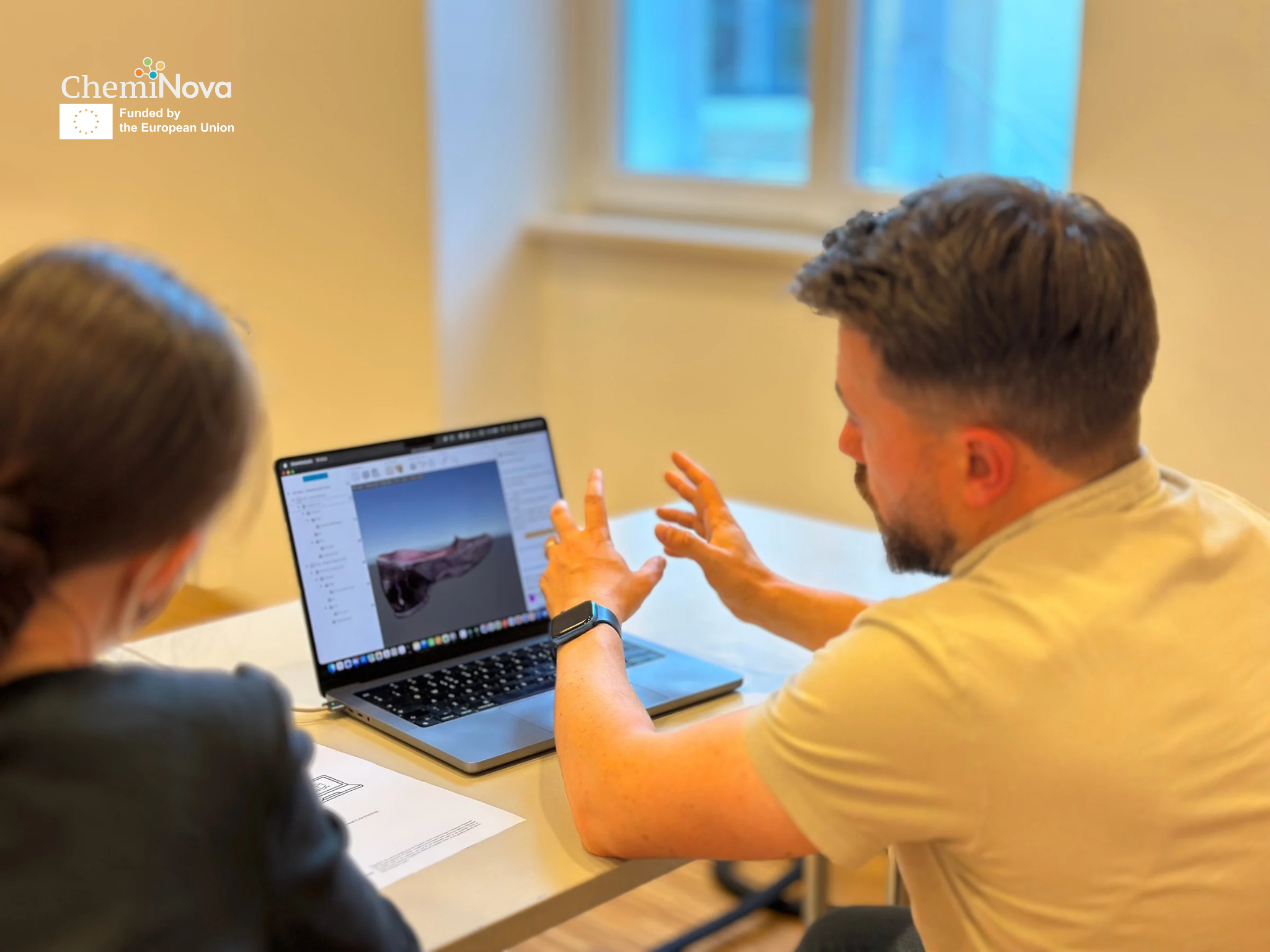
Entitled “An Integrated Workflow for Enriched 3D (e3D) Models to Support Conservation Practices in Cultural Heritage: The ChemiNova Project”, the article introduces an integrated workflow for combining geometric information and heterogeneous scientific datasets within enriched 3D models to support the analysis, inspection and monitoring of cultural heritage assets.
Integrating scientific data into 3D models
Cultural heritage conservation increasingly relies on the integration of information from different sources and analytical techniques. However, bringing these datasets together in a coherent and accessible environment remains a significant challenge.
The workflow presented in the paper addresses this challenge by spatially integrating multiple, co-registered data layers within enriched 3D (e3D) models. This approach allows users to access and visualise different types of information associated with a heritage asset, supporting its investigation and condition monitoring.
The ChemiNova Suite
The paper presents the workflow alongside the database architecture supporting the storage, linkage and retrieval of complex multimodal data.
The ChemiNova Suite comprises three interactive applications:
- ChemiAnalysis, a desktop-based application for data analysis.
- ChemiInspection, an augmented reality-based application for on-site inspection.
- ChemiSensing, a collaborative virtual environment.
These applications are supported by ChemiPortal, a shared data management gateway, and ChemiAI, an automated damage prediction module.
Together, these components aim to connect scientific data acquisition, analysis, visualisation and damage assessment within an integrated digital environment.
Demonstrating the workflow at La Nau
The methodology is demonstrated through selected cultural heritage elements at La Nau, the Cultural Centre of the University of Valencia, one of ChemiNova’s pilot sites.
The paper also discusses the interdisciplinary collaboration involved in designing and assessing the workflow, highlighting the importance of connecting digital innovation, scientific investigation and conservation practice.
By bringing different datasets together in enriched 3D models, the proposed approach contributes to the development of integrated digital tools for cultural heritage conservation and monitoring.
Read the publication
The article is available as an open-access publication in Electronics (MDPI).
Reference: Palma, B. et al. (2026). An Integrated Workflow for Enriched 3D (e3D) Models to Support Conservation Practices in Cultural Heritage: The ChemiNova Project. Electronics, 15(20), 4783.