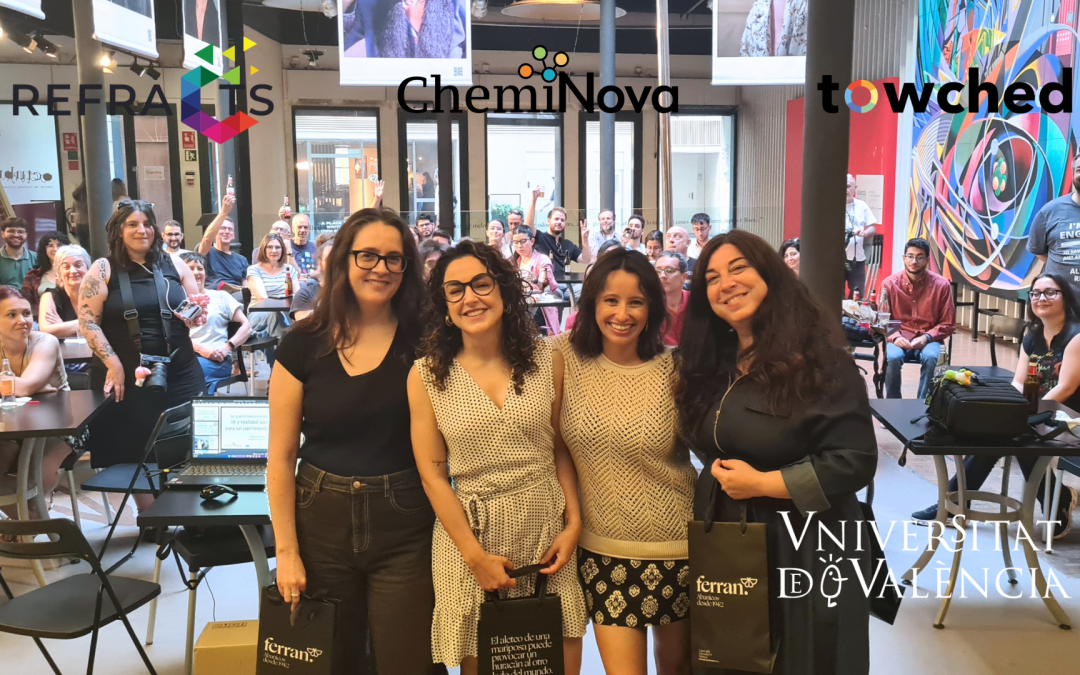
The event brought together researchers, students, and the general public in Valencia to debate cultural heritage, artificial intelligence, and open science in a relaxed atmosphere.
Discussing cultural heritage over a beer. That was the starting point for a new edition of DataBeers VLC, the popular science event that once again brought together researchers, students, and citizens in Valencia to share knowledge outside traditional academic settings.
Under the title “Conserving, Teaching, and Opening Up: Cultural Heritage in the key of data”, the event was held at the Octubre Centre de Cultura Contemporània and explored how digital technologies are transforming the way cultural heritage is studied, conserved, and communicated. All of this took place in a warm, participatory format that blends one of the most recognisable social traditions—sharing a beer and a chat—with topical scientific and technological issues.
The event was supported by the European FORTHEM Alliance and the TOWCHED and ChemiNova projects, funded by the Horizon Europe programme, as well as the REFRACTS project, a PROMETEO (CIPROM, GVA) initiative driven by the Generalitat Valenciana (the Valencian Regional Government). The programme focused on research developed at the University of Valencia, featuring specialists from the Department of Art History and the University Institute of Robotics and Information and Communication Technologies (IRTIC).
Dr Cristina Portalés, project coordinator of ChemiNova and Professor at the University of Valencia’s Department of Computer Science, presented how artificial intelligence, augmented reality, and different layers of imaging techniques allows for the creation of “enriched 3D models”, capable of detecting damage invisible to the human eye in cultural assets threatened by climate change or armed conflicts.
Meanwhile, Dr Arabella León, a researcher at the University of Valencia’s Department of Art History and a member of the REFRACTS project, addressed the use of artificial intelligence and virtual reality to rescue overlooked archives and female creators, reflecting on the potential of digital tools to reinterpret cultural memory from new perspectives.
Dr Mar Gaitán, also a researcher at the University of Valencia’s Department of Art History, focused her talk on assessing the social impact of art and the Sustainable Development Goals within the TOWCHED project, highlighting the importance of developing methodologies capable of measuring the social and transformative dimension of culture.
The session closed with Ester Alba, Professor at the University of Valencia’s Department of Art History and principal investigator of the TOWCHED, REFRACTS, and ChemiNova projects. She closed the event by underlining the need to bring university research closer to the public and to create open, accessible spaces for dialogue.
Since 2016, DataBeers VLC has established itself as one of the leading spaces for data science dissemination in Valencia, forming part of the international DataBeers network, which is active in more than twenty cities worldwide. Its format, based on short presentations and an informal atmosphere, seeks to build bridges between academia and society, proving that complex issues like artificial intelligence or safeguarding heritage can also be debated in everyday spaces, amidst questions, conversation, and shared beers.