2–5 November 2026 | Barcelona, Spain
The EU-funded ChemiNova project participated in the 23rd Eurographics Workshop on Graphics and Cultural Heritage (GCH 2026), held from 2 to 5 November at the Universitat Politècnica de Catalunya (UPC) in Barcelona.
Organised by the ViRVIG research centre at UPC, with the support of Eurographics, the workshop brought together researchers, heritage professionals and institutions working at the intersection of computer graphics and cultural heritage.
ChemiNovaKids: augmented reality for heritage participation
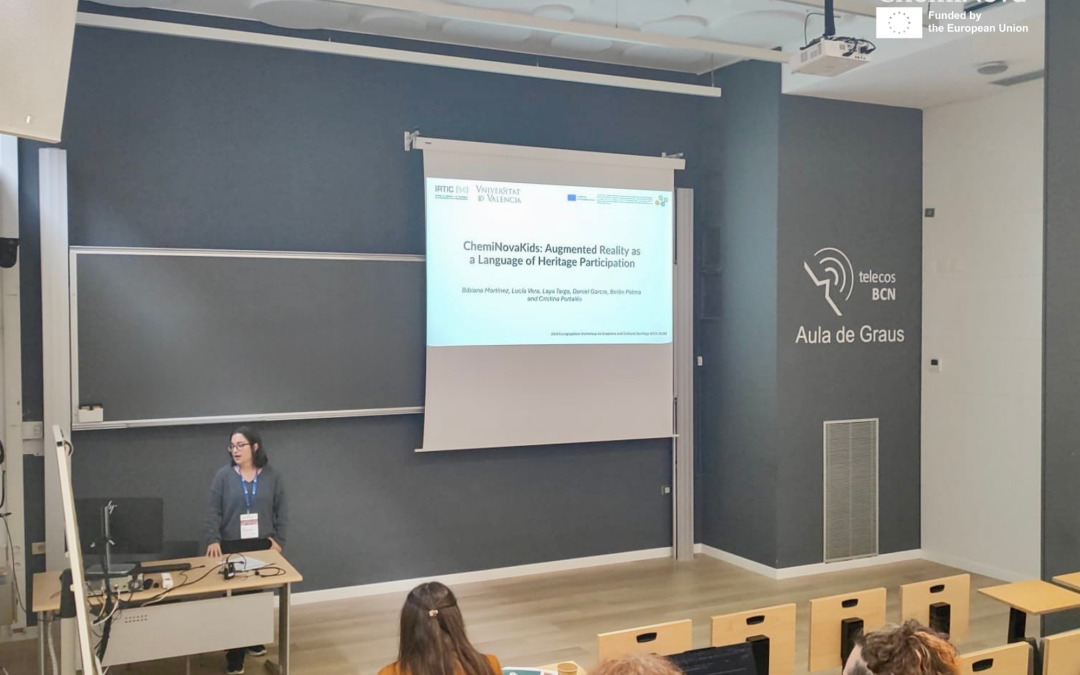
On 2 November, Laya Targa presented the contribution “ChemiNovaKids: Augmented Reality as a Language of Heritage Participation” during the session XR, Storytelling & Audience Engagement, within the GCH Short Papers track.
The work, co-authored by Bibiana Martínez, Lucía Vera, Laya Targa, Daniel Garcia, Belén Palma and Cristina Portalés, explores the potential of augmented reality (AR) as a tool for encouraging engagement and participation in cultural heritage, with particular attention to younger audiences.
By considering augmented reality as a language through which people can interact with and experience heritage, ChemiNovaKids contributes to the exploration of new approaches to heritage communication, learning and participation.
This perspective complements the project’s wider research objectives, highlighting the importance of digital technologies not only for heritage inspection and condition assessment, but also for improving the ways in which people access, understand and connect with cultural heritage.
Connecting digital innovation and public engagement
GCH 2026 provided an interdisciplinary environment for discussing emerging technologies and their applications in cultural heritage.
ChemiNova’s contribution to the workshop reinforces the project’s interest in exploring the broader potential of digital innovation, bringing together technological development, heritage research and public engagement.
ChemiNova would like to congratulate Laya Targa for presenting this work and thank all the co-authors for their contribution.